

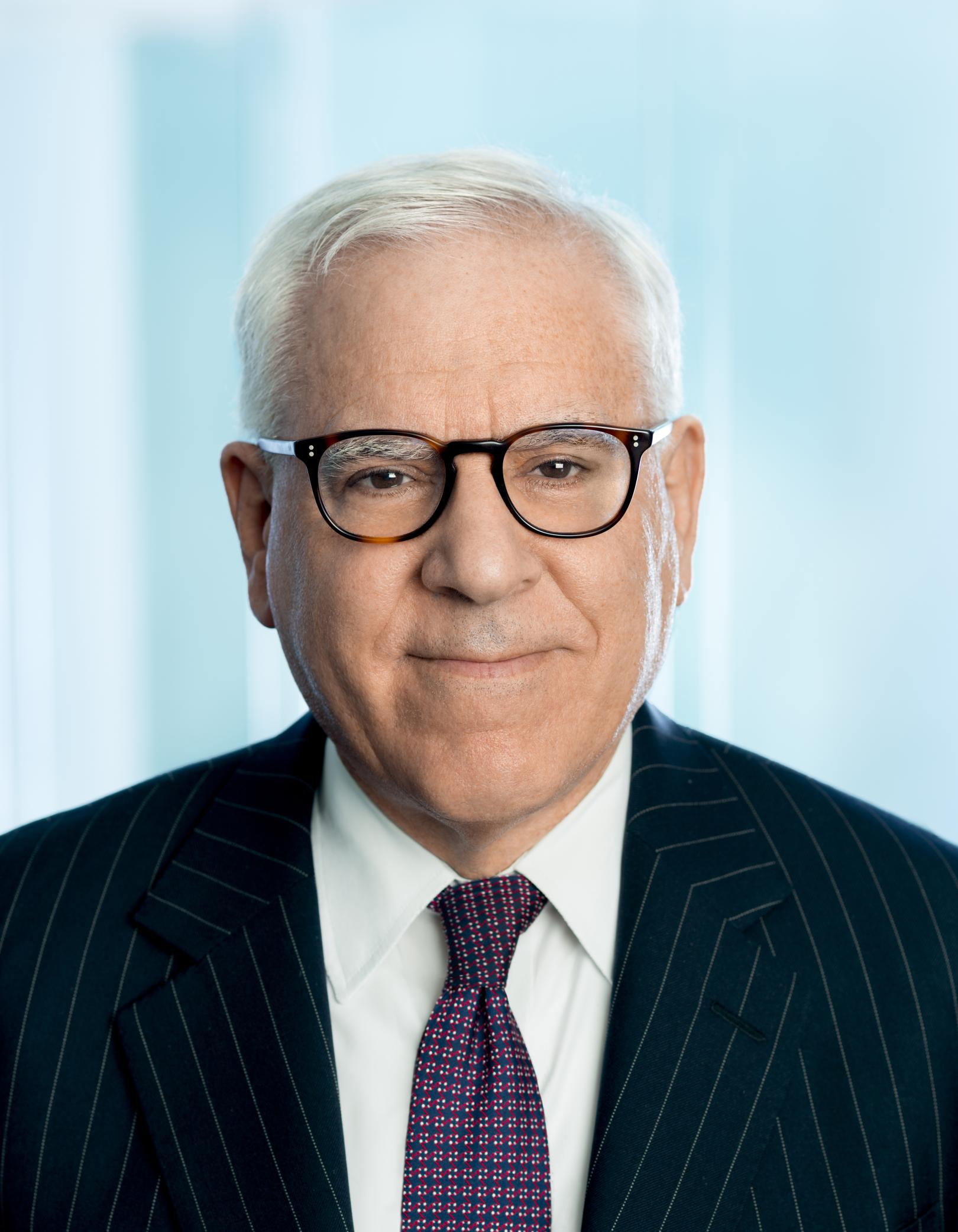
Award: Bower Award for Business Leadership
Affiliation: The Carlyle Group │ Washington, DC
The Carlyle Group │ Washington, DC
For embodying the legacy of Benjamin Franklin by blending visionary entrepreneurship with a profound commitment to the public good. Through his remarkable success as co-founder of The Carlyle Group and his passionate dedication to patriotic philanthropy, the arts, health, education, and civic engagement, he exemplifies the values that define the American spirit.
In the National Archives in Washington, D.C., visitors expect to see the Declaration of Independence and the Constitution. Few expect to encounter a much older document—a 1297 Magna Carta—displayed in the same civic setting. That parchment is on long-term loan from David M. Rubenstein, who bought it and placed it where the public can study it. The gesture is characteristic: Ensuring public access through the support of private means.
Rubenstein is best known as the co-founder and co-chairman of The Carlyle Group, the private investment firm he helped launch in 1987. As his career has matured, he has become equally identified with philanthropy, especially what he calls “patriotic philanthropy,” large-scale giving aimed at preserving national landmarks and the institutions that steward American history.
His story begins in Baltimore, Maryland, where he was born in 1949 and raised in a modest, working-class household. Scholarships and part-time work opened doors that would otherwise have been closed. He attended Duke University, graduating magna cum laude and joining Phi Beta Kappa, then went on to earn his JD at the University of Chicago Law School, where he served as an editor of the Law Review.
Early on, Rubenstein’s ambition was public service. After practicing law, he worked in Washington as chief counsel to a U.S. Senate Judiciary subcommittee and then joined the Carter administration as Deputy Assistant to the President for Domestic Policy. The experience gave him a close-up view of how government decisions are made. After leaving the White House, he returned to private practice in Washington before co-founding Carlyle.
Investing, restructuring, and building businesses through Carlyle helped make Rubenstein a prominent figure in the global private equity industry. But his public imprint is not only in deal-making. It is also in what his success allowed him to underwrite: cultural infrastructure, civic memory, and the idea that some parts of a nation’s story should be available to everyone, not hidden behind paywalls or tucked away in private collections.
That philosophy shows up most visibly in the restoration and repair of national landmarks. Rubenstein has been a major supporter of projects tied to the Washington Monument and the Lincoln Memorial, among other national sites. His personal giving totaling more than $1 billion makes him one of the largest individual contributors to a number of landmark initiatives. It is also visible in museums and archives, places where democracy is kept not just in law, but in material form. The National Archives’ “Records of Rights” exhibition, housed in the David M. Rubenstein Gallery, makes civic texts tangible to the public; the loaned Magna Carta is its striking anchor. Rather than treating historical artifacts as trophies, Rubenstein has emphasized long-term loans that put rare materials into public institutions. The point is not simply preservation. It is circulation: documents and objects made available for students, scholars, and citizens.
Rubenstein’s institutional leadership mirrors that same dedication to stewardship. He has chaired boards at organizations that shape civic and cultural life, including the Council on Foreign Relations and the National Gallery of Art. He is also an original signer of the Giving Pledge, aligning himself with the principle that a substantial share of private wealth should be directed to philanthropic purposes. This commitment is made clear not only in his patriotic philanthropy but in the hundreds of millions of dollars he has donated to higher education, health initiatives, and the performing arts.
In recent years, Rubenstein has built a second kind of public platform: conversation. Through “The David Rubenstein Show: Peer-to-Peer Conversations,” he conducts long-form interviews with leaders across business, government, and culture, treating biography as a source of practical lessons about judgment, responsibility, and power. Long before the television cameras, he was already doing a version of this work as president of the Economic Club of Washington, D.C., where he has conducted more than 130 public interviews. His books extend his trademark approach, using interviews and American history to explore leadership, investing, and the presidency. He is the author of five books, including The American Story, How to Lead, and How to Invest, and he hosts related series on Bloomberg and PBS.
In January 2025, Rubenstein received the Presidential Medal of Freedom, the nation’s highest civilian honor, an acknowledgment that his influence has reached well beyond finance into the cultural and civic institutions he has supported. Even with a national profile, Rubenstein’s story keeps circling back to Baltimore. In 2024, an ownership group led by Rubenstein acquired control of Major League Baseball’s Baltimore Orioles, making a Baltimore native the principal owner of one of the city’s most visible institutions. It was a business transaction, but also a homecoming, an emblem of how his life has moved between private achievement and public place.
David M. Rubenstein was born and raised in Baltimore, Maryland. He earned a B.A. from Duke University and a J.D. from the University of Chicago Law School before a storied career in government, law, and finance.
Information as of March 2026